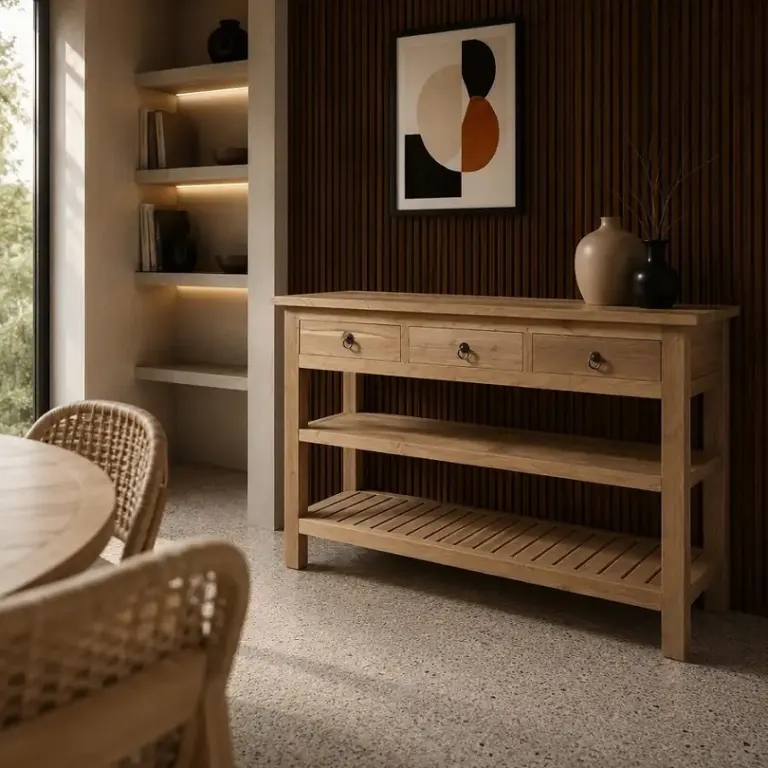
Solid Wood Console Models – Import and Export, Turkey: Solid Hardwood vs. Engineered Veneer Total Landed Cost, Tariff Engineering, and Commercial ROI Analysis
For international furniture importers, retail category directors, hospitality FF&E purchasing managers, and Turkish export manufacturers, one of the most consequential commercial decisions in product line architecture is determining when to specify 100% solid hardwood construction versus architectural hardwood veneers over engineered substrates.

In Solid Wood Console Models – Import and Export, Turkey: Solid Hardwood vs. Engineered Veneer Total Landed Cost, Tariff Engineering, and Commercial ROI Analysis, we move beyond superficial aesthetic comparisons to examine the hard financial, structural, customs-tariff, freight-density, and lifecycle return-on-investment (ROI) metrics governing cross-border console trade.
Because Turkey possesses both deep domestic reserves of kiln-dried temperate hardwoods (Anatolian Walnut, Sessile Oak, Oriental Beech, European Ash) and Europe’s largest, most technologically advanced E0/CARB-P2 MDF and slice-cut veneer manufacturing infrastructure, Turkish export factories offer buyers complete flexibility across both material architectures. However, choosing the wrong construction method for a target price tier, climate zone, or freight corridor erodes gross margins through excessive container cubic weight, customs classification disputes, or post-sale humidity warranty claims. This authoritative technical and financial manual dissects every variable of Solid Wood Console Models – Import and Export, Turkey: Solid Hardwood vs. Engineered Veneer Total Landed Cost, Tariff Engineering, and Commercial ROI Analysis.
1. Structural Engineering & Physical Performance Comparison
Evaluating Solid Wood Console Models – Import and Export, Turkey: Solid Hardwood vs. Engineered Veneer Total Landed Cost, Tariff Engineering, and Commercial ROI Analysis requires first contrasting how solid timber and veneered engineered panels behave under mechanical load, thermal shifts, and daily consumer wear.
Technical Engineering Matrix: 100% Solid Hardwood vs. Architectural Veneered Core
Performance Parameter 100% Solid Hardwood Console (FAS Kiln-Dried Oak / Walnut / Ash) Architectural Veneered Console (0.6mm–1.5mm Natural Veneer over E0 MDF / Birch Plywood) Commercial & Engineering Implication
Dimensional Stability (Hygroscopic Movement) Anisotropic; expands/contracts 4%–8% across tangential grain width with seasonal RH swings; requires slotted expansion fasteners Isotropic core stability (< 0.2% dimensional change); resists seasonal warping across extra-long spans (200–280 cm) Solid wood requires strict 6.5%–8.5% EMC kiln calibration; engineered cores tolerate harsher HVAC swings
Edge Impact & Dent Resistance High; solid bullnose, chamfered, or sculpted edges can be sanded out and spot-refinished if dented Vulnerable at sharp 90° corners unless reinforced with 3mm–5mm solid hardwood edge lipping prior to veneering Hybrid construction (solid wood edges/legs + veneered flat panels) combines impact toughness with panel flatness
Refinishability & Lifespan Heirloom longevity (30–50+ years); entire tabletop can be machine-sanded and refinished multiple times Limited to 1–2 light hand-sandings (if 1.2mm–1.5mm thick architectural veneer is specified) Solid wood commands 2.2x–3.5x higher retail price points and luxury resale positioning
Unit Net Weight (150 x 38 x 80 cm Console) Heavy (42 kg to 68 kg depending on species density and slab thickness) Moderate (26 kg to 38 kg; or 19 kg if torsion-box honeycomb core is utilized) Solid wood increases air/parcel courier DIM/weight costs; lighter cores reduce last-mile parcel fees
CNC Fluting & Sculptural Milling Suitable for deep 3D carving, turned cabriole legs, and organic live-edge silhouettes Superior for crisp, uniform micro-fluted tambour profiles and geometric book-matched grain patterns Choice depends on whether design intent prioritizes organic sculptural depth or geometric symmetry
2. Bill of Materials (BOM) and FOB Turkey Factory Cost Breakdown
In Solid Wood Console Models – Import and Export, Turkey: Solid Hardwood vs. Engineered Veneer Total Landed Cost, Tariff Engineering, and Commercial ROI Analysis, understanding Turkish factory cost accounting enables importers to value-engineer specifications without sacrificing perceived luxury.
Representative Ex-Works / FOB Istanbul Cost Structure (150 x 38 x 80 cm Designer Console, 100-Unit Batch)
Cost Component 100% Solid Anatolian Oak Console (FOB USD) Hybrid Console (Solid Oak Legs/Edges + Oak Veneered E0 MDF Carcass) (FOB USD) 100% Oak-Veneered E0 MDF Flat-Pack Console (FOB USD)
Primary Wood / Substrate Material $118.00 (0.14 m³ FAS Kiln-Dried Oak @ $840/m³) $54.00 (Solid oak legs/lipping + E0 MDF + 0.6mm crown-cut veneer) $34.00 (18mm E0 MDF + balanced oak veneer + PVC/veneer edge tape)
CNC Machining, Joinery & Sanding $46.00 (Stave glue-up, mortise-tenon, slotted cleats, 4-stage sanding) $36.00 (Hydraulic hot-pressing, PUR lipping, CNC boring) $24.00 (Automated nesting router, edge-banding, cam-lock drilling)
Hardware (Soft-Close Runners / Inserts) $18.00 (Blum/Hettich concealed slides + brass inserts) $18.00 (Blum/Hettich concealed slides + cam-lock hardware) $12.00 (Standard ball-bearing slides + zinc cam locks)
Surface Finishing (2K PU / Hardwax Oil) $32.00 (6-side balanced Rubio/Osmo hardwax oil or satin acrylic-PU) $26.00 (Automated spray line 2K satin polyurethane) $19.00 (UV flat-line roller coating)
Export Packaging (ISTA 3A / Crating) $28.00 (Reinforced corner blocks, vapor barrier, heavy double-wall carton) $20.00 (Knock-down EPE foam channels + 5-ply kraft carton) $14.00 (Compact RTA flat-pack carton)
Factory Overhead, QC & Export Margin $43.00 $31.00 $21.00
Total FOB Turkey Unit Price $285.00 $185.00 $124.00
As demonstrated in this BOM breakdown for Solid Wood Console Models – Import and Export, Turkey: Solid Hardwood vs. Engineered Veneer Total Landed Cost, Tariff Engineering, and Commercial ROI Analysis, adopting a Hybrid Solid-Edge / Veneered-Carcass Architecture reduces FOB factory cost by 35% compared to 100% solid hardwood while retaining authentic solid timber touchpoints along every edge, leg, and drawer front.
3. Total Landed Cost (TLC) Modeling: Freight, Customs Duties, and Compliance Fees
A low FOB price does not guarantee retail profitability. True commercial competitiveness in Solid Wood Console Models – Import and Export, Turkey: Solid Hardwood vs. Engineered Veneer Total Landed Cost, Tariff Engineering, and Commercial ROI Analysis is measured at the destination warehouse door through Total Landed Cost (TLC) modeling across a 40-foot High Cube (40' HC) container (68 CBM loadable capacity).
Landed Cost Comparison: Exporting from Turkey to United States (New York) vs. European Union (Rotterdam)
Landed Cost Variable (Per Console Unit) 100% Solid Oak Console (KD Legs Detached) Hybrid Solid/Veneer Console (KD Frame) Veneered E0 MDF Console (Flat-Pack RTA)
FOB Turkey Unit Price $285.00 $185.00 $124.00
Units Loaded per 40' HC Container (68 CBM) 210 units (0.32 CBM/unit) 280 units (0.24 CBM/unit) 480 units (0.14 CBM/unit)
Ocean Freight + Marine Insurance (Clause A) (Est. $3,800/40' HC to US East Coast or €2,400 to EU) $18.10 (US) / €11.43 (EU) $13.57 (US) / €8.57 (EU) $7.92 (US) / €5.00 (EU)
Import Customs Duty (HS 9403.60) (0% EU via A.TR; 0% UK via FTA; 0% US MFN) $0.00 / €0.00 $0.00 / €0.00 $0.00 / €0.00
Regulatory Compliance Cost Allocation (US Lacey Act PPQ 505 / CARB P2 / EUDR DDS) $1.40 (Single botanical species filing: Quercus petraea) $2.10 (Multi-species filing: Oak + Beech/Pine MDF fiber) $2.35 (Composite TSCA Title VI TPC audit + multi-fiber declaration)
Destination Port Handling, Drayage & Customs Brokerage $8.50 $6.40 $3.75
Total Landed Cost at Destination Warehouse $313.00 (US) $207.07 (US) $138.02 (US)
Target Wholesale / Retail Price Positioning $890 – $1,290 Retail (65%–75% Gross Margin) $590 – $790 Retail (65%–74% Gross Margin) $349 – $449 Retail (60%–69% Gross Margin)
4. Tariff Engineering and Customs Classification Nuances
Within Solid Wood Console Models – Import and Export, Turkey: Solid Hardwood vs. Engineered Veneer Total Landed Cost, Tariff Engineering, and Commercial ROI Analysis, subtle material substitutions can alter Harmonized System (HS) classification, preferential origin qualification, and non-tariff regulatory burdens:
1. Rules of Origin Qualification (A.TR vs. EUR.1 / UK FTA)
• EU-Turkey Customs Union (A.TR Certificate): Applies to goods in "free circulation" in Turkey. Even if a Turkish factory imports American Walnut veneer or German beech logs, once processed into a finished console in Turkey with import duties paid, it circulates into the EU at 0% customs duty under an A.TR certificate.
• UK-Turkey FTA & EFTA / MENA FTAs (Origin Declaration / EUR.1): Requires satisfying specific Rules of Origin (typically a Change in Tariff Heading from raw wood HS 4407/4408/4411 to finished furniture HS 9403, or meeting minimum Turkish domestic value-added thresholds). Utilizing domestic Anatolian oak, walnut, and Turkish-manufactured E0 MDF guarantees 100% effortless Turkish origin qualification.
2. US Lacey Act & TSCA Title VI Simplification via Solid Timber
• Importers shipping veneered MDF consoles to the United States must track and declare the exact botanical genus and species of every wood fiber inside the MDF core (which often blends pine, spruce, beech, and poplar chips from multiple sawmill sources) alongside CARB Phase 2 / EPA TSCA Title VI formaldehyde certification.
• Conversely, a 100% Solid Anatolian Oak or Walnut Console requires only a single-species Lacey Act declaration (Quercus petraea or Juglans regia, Country of Harvest: Turkey) and is completely exempt from composite wood formaldehyde testing mandates—accelerating US customs clearance and eliminating lab compliance fees.
3. Importing Consoles into Turkey: Additional Customs Duty (İGV) Impact
For Turkish retailers importing foreign consoles into Turkey from non-FTA countries (such as China or Vietnam), both solid wood and veneered consoles under HS 9403.60 face steep Additional Customs Duties (İlave Gümrük Vergisi – İGV) of 20% to 50% plus 20% VAT (KDV). Because İGV is assessed ad valorem on the CIF value, domestic Turkish manufacturing or importing duty-free from EU design partners via A.TR provides an overwhelming fiscal advantage.
5. Warranty Risk, Defect Rates, and Lifecycle ROI Analysis
Commercial ROI in Solid Wood Console Models – Import and Export, Turkey: Solid Hardwood vs. Engineered Veneer Total Landed Cost, Tariff Engineering, and Commercial ROI Analysis must account for post-sale warranty claims, customer returns, and brand equity over a 5-year product lifecycle:
Comparative Risk & Return Profile by Sales Channel
1. Luxury Brick-and-Mortar Showrooms & Interior Design Trade:
• Optimal Choice: 100% Solid Hardwood (or Thick 1.5mm Architectural Veneer over Baltic Birch Plywood for extra-wide waterfall designs).
• Financial Rationale: Affluent design clients inspect underside joinery, drawer box construction, and solid wood weight. Solid Anatolian Walnut or Oak consoles command 3.2x to 4.0x retail markups, generate organic word-of-mouth referrals, and incur near-zero structural return rates when kiln-dried to 8.0% EMC.
2. Omni-Channel Mid-Market Retail Chains & Boutique Hospitality (4-Star Hotels):
• Optimal Choice: Hybrid Architecture (Solid hardwood legs, frames, and 4mm solid wood edge lipping paired with book-matched natural veneer over high-density E0 MDF panels).
• Financial Rationale: Delivers 90% of the visual and tactile richness of solid wood at 35% lower FOB cost, resists warping in centrally heated/cooled commercial interiors, and fits 33% more units per 40' HC container.
3. High-Volume E-Commerce / Direct-to-Consumer (DTC) Parcel Fulfillment:
• Optimal Choice: Lightweight Engineered Torsion-Box Veneer / RTA Construction (or Slender Knock-Down Solid Ash/Oak under 22 kg).
• Financial Rationale: Keeps gross parcel weight below UPS/FedEx/DHL heavy-package surcharge thresholds (< 22.5 kg) and maximizes 40' HC container density (450+ units), protecting net contribution margin after paid digital customer acquisition costs (CAC).
6. Strategic Decision Framework for Global Furniture Buyers
To optimize portfolio margins under Solid Wood Console Models – Import and Export, Turkey: Solid Hardwood vs. Engineered Veneer Total Landed Cost, Tariff Engineering, and Commercial ROI Analysis, apply this four-step procurement matrix when issuing RFQs to Turkish manufacturers:
• Rule 1 – Match Substrate to Span & Climate: Specify 100% solid hardwood for sculptural, carved, live-edge, and heirloom consoles up to 180 cm length; specify architectural veneer over E0 MDF or blockboard for extra-long 200–280 cm minimalist spans or high-humidity coastal resort environments.
• Rule 2 – Mandate Solid Wood Edge Protection on All Veneered Tops: Never accept thin 0.4mm PVC edge tape on export veneered consoles; specify 3mm to 5mm solid hardwood edge lipping bonded with moisture-proof PUR adhesive to eliminate corner chipping during transit and home use.
• Rule 3 – Benchmark Container-Landed Cost, Not Ex-Works Price: Always compare suppliers on Total Landed Cost per Unit at Destination Warehouse (FOB + Ocean/Road Freight per CBM + Compliance Fees + Projected Return Allowance) rather than raw factory unit quotes.
• Rule 4 – Build Tiered Good-Better-Best Collections in Turkey: Leverage Turkey’s versatile manufacturing clusters to source an entry-tier RTA veneered console ($124 FOB), a core mid-tier hybrid solid-edge console ($185 FOB), and a flagship 100% solid Anatolian walnut console ($285+ FOB) within a single consolidated supply program.