Forged Iron, Mortise Joinery, and Global Supply Chain Benchmarks: Hardware Metallurgy, Structural Engineering, and Competitive Positioning of Distressed Solid Wood TV Units in Turkey
In luxury residential architecture and commercial interior design, a distressed solid wood media console is defined as much by its structural joinery and architectural metalwork as by its weathered timber surfaces.
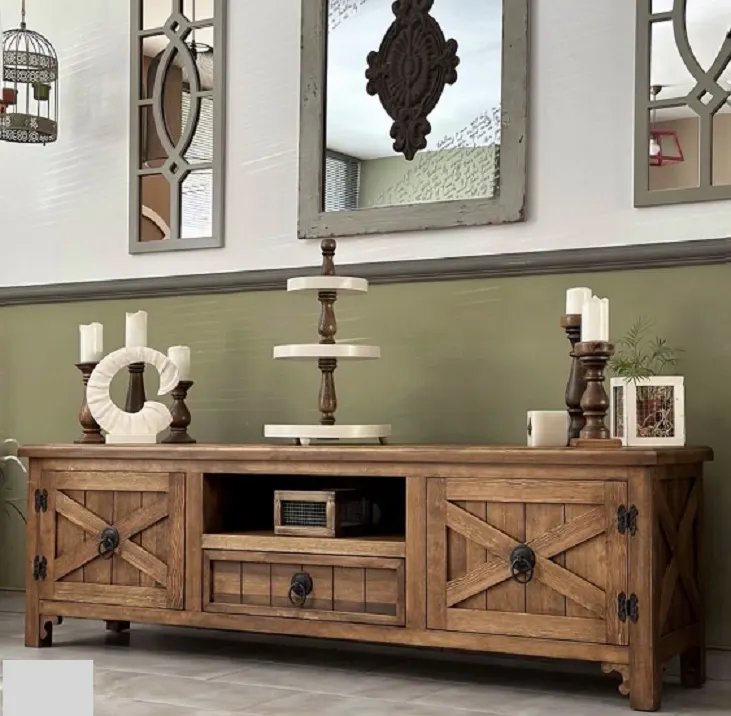
When a 220-centimeter solid Anatolian chestnut or American white oak credenza supports an 85-inch display, heavy amplification gear, and daily family interaction over decades, hidden mechanical engineering determines whether the piece becomes a cherished heirloom or suffers from sagging tops, racking frames, and binding drawers. Examining these structural mechanics alongside Turkey’s competitive standing in global furniture procurement is the central mission of Forged Iron, Mortise Joinery, and Global Supply Chain Benchmarks: Hardware Metallurgy, Structural Engineering, and Competitive Positioning of Distressed Solid Wood TV Units in Turkey.
Across Turkey’s premier woodworking clusters—spanning İnegöl, Ankara (Siteler), Kayseri, İstanbul, and İzmir—manufacturers combine traditional Anatolian blacksmithing and cabinetmaking heritage with precision European CNC engineering. Simultaneously, shifting global trade policies, trans-Pacific freight volatility, and strict environmental mandates have propelled Turkey ahead of traditional furniture-exporting rivals in East Asia and Eastern Europe. Whether you are a product engineer specifying custom sand-cast brass hardware and hidden steel anti-sag channels, an architectural specifier evaluating joinery tolerances, or a global sourcing executive benchmarking Turkish landed costs against Vietnam and Poland, Forged Iron, Mortise Joinery, and Global Supply Chain Benchmarks: Hardware Metallurgy, Structural Engineering, and Competitive Positioning of Distressed Solid Wood TV Units in Turkey provides an exhaustive, authoritative technical blueprint.
1. Structural Joinery Mechanics in Heavy-Load Solid Wood Media Consoles
Unlike decorative accent tables, a solid wood TV unit is a high-stress load-bearing structure. It must resist three distinct mechanical failure modes: vertical creep deflection across wide horizontal spans, lateral racking when shifted across floors, and hygroscopic cross-grain splitting caused by seasonal indoor humidity fluctuations. Within Forged Iron, Mortise Joinery, and Global Supply Chain Benchmarks: Hardware Metallurgy, Structural Engineering, and Competitive Positioning of Distressed Solid Wood TV Units in Turkey, top-tier Turkish engineers eliminate these failures through time-tested joinery reinforced by modern structural hardware.
1. Haunched Mortise-and-Tenon Frame Construction
While mass-market flat-pack consoles rely on cam-locks, plastic dowels, or pocket screws that loosen under vibration, export-grade Turkish solid wood TV units utilize haunched mortise-and-tenon joinery at all primary corner posts and apron intersections:
• Dimensional Proportions: Tenon thickness is milled to roughly one-third of the rail thickness (typically 10 mm to 12 mm on a 32 mm frame), with a depth extending 75% into the leg post.
• The Structural Haunch: A stepped shoulder ("haunch") at the top of the tenon sits inside a shallow groove along the upper leg, preventing the apron rail from twisting under heavy tabletop loads.
• Polymer Adhesive Bonding: Joints are bonded using EN 204 D4 rated crosslinking Polyurethane (PUR) or Polyvinyl Acetate (PVA) adhesives cured under pneumatic clamping pressure, creating a monolithic frame resistant to lateral racking.
2. English Dovetail & Lock-Miter Drawer Box Engineering
Drawers inside distressed solid wood TV units frequently store heavy vinyl records, gaming accessories, and dense media libraries. Turkish cabinetmakers construct drawer boxes from 15 mm to 18 mm kiln-dried Turkish Steamed Beech (Fagus orientalis) or Baltic Birch plywood joined via precision CNC-milled English half-blind dovetails on the front and through-dovetails at the rear. The interlocking wedge geometry of dovetail pins and tails mechanically resists forward pulling forces even before adhesive is applied.
3. Movement-Compensating Tabletop Attachment Systems
Solid wood expands and contracts perpendicular to its grain by 3 mm to 6 mm across a 45 cm depth between humid summers and centrally heated winters. Rigidly gluing or screwing a solid oak top directly to cross-grain aprons or welded steel legs guarantees catastrophic splitting along glue lines. Leading Turkish factories employ three movement-compensating attachment mechanisms:
• Elongated Slotted Steel C-Channels: Two parallel 12 mm × 25 mm channels are routed into the underside of the solid wood top. Heavy-gauge galvanized steel C-channels are bolted inside using machine screws driven into threaded M6 brass inserts through 10 mm slotted holes—preventing sagging while allowing the wood to slide laterally as humidity changes.
• Figure-8 Desktop Fasteners & Steel Z-Clips: Recessed into internal apron mortises, these pivoting steel clips anchor the top securely downward while permitting unrestricted seasonal expansion.
• Pinned Breadboard Ends: On rustic plank-top media consoles, transverse solid wood breadboard ends are joined via a full-width stub tenon and three deep haunched tenons. Only the center tenon is glued and pinned rigidly; the outer two pins pass through elongated slots in the tenons, keeping the tabletop dead-flat across seasons.
2. Architectural Hardware Metallurgy and Custom Foundry Craft
A defining signature of Forged Iron, Mortise Joinery, and Global Supply Chain Benchmarks: Hardware Metallurgy, Structural Engineering, and Competitive Positioning of Distressed Solid Wood TV Units in Turkey is Turkey’s deep domestic ecosystem of metal foundries, blacksmith workshops, and precision hardware manufacturers. Rather than relying on generic stamped zinc pulls, Turkish furniture exporters integrate bespoke architectural metals engineered to age gracefully alongside distressed hardwood.
Custom Sand-Cast Brass, Bronze, and Wrought Iron Pulls
In manufacturing hubs such as İstanbul (Bayrampaşa & İkitelli), Bursa, and Ankara (Ostim & Siteler), specialized non-ferrous foundries and ironworks produce proprietary hardware exclusively for OEM/ODM furniture collections:
• Sand-Cast Solid Brass & Bronze: Molten brass (CuZn39Pb3) or silicon bronze is poured into green-sand molds, imparting a subtly pebbled, organic surface texture that mirrors hand-forged 19th-century hardware. After tumbling and hand-filing, pulls undergo chemical liver-of-sulfur or cupric nitrate patination to create deep antique bronze, oil-rubbed brass, or verdigris finishes, sealed with microcrystalline wax or clear lacquer.
• Hand-Forged Wrought Iron & Hot-Rolled Steel: For industrial-rustic and Anatolian farmhouse TV units, blacksmiths hot-forge low-carbon steel bar stock into custom ring pulls, sliding barn-door tracks, corner strap brackets, and riveted clavos studs. Surfaces are blackened via linseed-oil heat-quenching or matte-black architectural powder coating tested to ASTM B117 salt-spray corrosion standards (500+ hours).
Concealed High-Precision European & Turkish Motion Hardware
While exterior pulls and frames celebrate rugged antique metallurgy, interior moving parts deliver effortless modern ergonomics:
• Soft-Close Undermount Slides: Turkish exporters integrate concealed full-extension undermount runners from Austrian/German leaders (Blum Tandem, Hettich Quadro) alongside Tier-1 Turkish precision hardware manufacturers (Samet Smart Slide), rated for 30 kg to 40 kg dynamic loads and 50,000+ opening cycles.
• Concealed Cup Hinges & Magnetic Touch Latches: For handleless Modern Organic and Wabi-Sabi distressed consoles, 3D-adjustable soft-close cup hinges pair with heavy-duty magnetic push-to-open latches calibrated to overcome the mass of thick 25 mm solid oak doors.
3. Global Supply Chain Benchmarks: Turkey vs. Competing Furniture Hubs
To understand why international procurement executives are reallocating container volume toward Turkey, Forged Iron, Mortise Joinery, and Global Supply Chain Benchmarks: Hardware Metallurgy, Structural Engineering, and Competitive Positioning of Distressed Solid Wood TV Units in Turkey benchmarks Turkey against the world’s four primary solid-wood casegoods exporters: Vietnam, Poland, Romania, and China.
Comprehensive Cross-Country Procurement Comparison
Strategic Benchmark Turkey (İnegöl / Kayseri / Ankara) Vietnam (Bình Dương / Đồng Nai) Poland & Romania China (Guangdong / Shandong)
Primary Timber Species Anatolian Chestnut, American White Oak, European Oak, Beech Acacia, Rubberwood, Imported American Oak/Ash European Oak, Beech, Scots Pine Imported American Oak/Ash, Rubberwood, Birch
US Import Tariff (HS 9403.60) 0% (MFN Duty-Free) 0% (MFN Duty-Free) 0% (MFN Duty-Free) 25% Section 301 Punitive Tariff
EU Import Tariff 0% (via A.TR Customs Union) 0% (via EVFTA, strict origin rules) 0% (EU Single Market) 0% to 5.6% Standard MFN
Ocean Transit to US East Coast 16 – 22 Days (Direct) 32 – 42 Days (Trans-Pacific/Suez) 14 – 20 Days (North Atlantic) 30 – 38 Days
Road/Intermodal Transit to EU 5 – 9 Days 30 – 40 Days (Sea) 1 – 3 Days (Road) 32 – 42 Days (Sea)
Typical B2B MOQ per SKU 20 – 50 Units (High flexibility) 150 – 300+ Units (Rigid) 50 – 100 Units 100 – 300+ Units
Hand-Distressing & Glaze Skill Exceptional (Artisanal + CNC hybrid) High (Strong labor pool) Moderate (More automated/modern) High (Highly standardized)
Bespoke Prototyping Lead Time 14 – 21 Days 45 – 60 Days 30 – 45 Days 35 – 50 Days
Why Turkey Outperforms East Asia on Working Capital Velocity
While Vietnam offers slightly lower direct factory labor rates on massive 500-unit production runs of rubberwood or acacia furniture, Turkey delivers superior Return on Invested Capital (ROIC) for North American and European importers:
1. Inventory Turnover Speed: A 45-day production window plus 18-day ocean transit allows a US East Coast importer to turn inventory 4 to 5 times per year, compared to 2 times per year on 120-day trans-Pacific procurement cycles.
2. Lower MOQ Risk: Ordering 25 units per SKU across 5 distressed solid oak console designs inside a single 40' High Cube container enables retailers to test new finishes and sizes without tying up hundreds of thousands of dollars in slow-moving warehouse stock.
3. Superior Oak & Chestnut Metallurgy: For authentic heavy-grain oak and chestnut media consoles, Turkish finishers possess deeper institutional mastery of tannin fuming, wire brushing, and hand-wiped antique glazes than Eastern European factories geared primarily toward minimalist Scandinavian flat-panel furniture.
4. Import-Export Policy Synergy and Customs Engineering
Executing seamless cross-border operations within Forged Iron, Mortise Joinery, and Global Supply Chain Benchmarks: Hardware Metallurgy, Structural Engineering, and Competitive Positioning of Distressed Solid Wood TV Units in Turkey depends on leveraging Turkey’s favorable import-export tax architecture:
• Duty-Free Raw Material Imports (DİR): Under Turkey’s Inward Processing Regime (Dahilde İşleme Rejimi - DİR), Turkish furniture factories import rough-sawn American White Oak lumber (HS Code 4407), European birch plywood, and Austrian soft-close slides 100% exempt from customs duties and 20% VAT (KDV), provided the finished TV units are exported within the authorized period.
• 0% Tariff Access into EU, UK, and USA: Finished distressed solid wood TV units (HS Code 9403.60) enter all 27 European Union member states duty-free via an A.TR Movement Certificate, enter Great Britain and EFTA states duty-free via a EUR.1 certificate, and enter the United States at 0% MFN duty (HTSUS 9403.60.8081) completely exempt from Section 301 tariffs.
• Full Environmental & Regulatory Traceability: Tier-one Turkish exporters provide verifiable EU Deforestation Regulation (EUDR) polygon geolocation coordinates, FSC® Chain-of-Custody certification, US Lacey Act (PPQ Form 505) species declarations, and ASTM F2057 / STURDY Act anti-tip steel cable restraint kits in every carton.
5. Technical Procurement Checklist for Architectural & Retail Buyers
To translate the insights of Forged Iron, Mortise Joinery, and Global Supply Chain Benchmarks: Hardware Metallurgy, Structural Engineering, and Competitive Positioning of Distressed Solid Wood TV Units in Turkey into an airtight purchase contract, buyers should mandate seven non-negotiable engineering clauses:
1. Kiln Moisture Specification: Core timber moisture content strictly 7.5% ± 0.5% for North America/Central Europe (or 9.5% ± 0.5% for humid coastal regions), verified via calibrated pinless and pin-type meters.
2. Joinery Standard: Haunched mortise-and-tenon primary carcass frames bonded with EN 204 D4 adhesive; English dovetail drawer boxes; zero structural staples or butt joints.
3. Anti-Sag & Movement Compensation: Hidden galvanized steel C-channels recessed into tops ≥ 160 cm wide, mounted with slotted fasteners; tabletops attached via Z-clips or elongated slots to permit cross-grain expansion.
4. Hardware Metallurgy: Solid sand-cast brass or salt-spray tested (ASTM B117) powder-coated steel exterior hardware; full-extension soft-close undermount drawer slides rated ≥ 35 kg.
5. Finish Durability & VOC Compliance: Multi-step chemical/glaze patina sealed with 2K polyurethane or conversion varnish (6–12 gloss units), tested to ISO 2409 Class 0 cross-hatch adhesion and compliant with EU REACH / US TSCA Title VI.
6. Spectrophotometric Color Governance: Batch approval conducted inside D65 standardized daylight booths (6500K) against a signed three-panel Control Color Range Board.
7. Packaging & Container Moisture Protocol: ISTA-3A drop-tested 7-ply cartons with 40 mm high-density EPE perimeter foam, container floor moisture < 14%, and calcium chloride desiccant poles hung inside every container.
Frequently Asked Questions (FAQ)
How do Turkish furniture makers prevent long solid wood TV unit tops from sagging or cracking?
Turkish engineers mill recessed dados into the underside of solid wood tops ≥ 160 cm long and bolt heavy-duty galvanized steel C-channels into place using slotted screw holes. Tops are attached to cabinet bases using figure-8 fasteners or Z-clips rather than rigid glue, allowing the timber to expand and contract seasonally without splitting.
Why does Turkey have a landed-cost advantage over China and Vietnam for solid wood TV units?
Turkish living room furniture (HS Code 9403.60) enters both the United States (0% MFN duty) and the European Union (0% duty via A.TR certificate) completely tariff-free, avoiding the 25% Section 301 tariffs applied to Chinese furniture. Combined with 16–22 day ocean transit to the US East Coast and 5–9 day transit to Europe, buyers achieve faster inventory turnover and lower working capital tie-up.
Can Turkish manufacturers produce custom solid brass or forged iron hardware for private-label TV units?
Yes. Turkey has an extensive domestic foundry and metalworking industry in İstanbul, Bursa, and Ankara that produces bespoke sand-cast solid brass pulls, chemically patinated bronze hardware, and hot-forged wrought iron frames and barn-door tracks tailored to OEM/ODM buyer drawings.
What drawer construction is standard in export-grade Turkish distressed solid wood TV units?
Export-grade Turkish consoles feature 15–18 mm kiln-dried steamed beech or birch plywood drawer boxes assembled with interlocking English dovetail joinery and mounted on concealed full-extension soft-close undermount slides (Blum, Hettich, or Samet) rated for 30–40 kg dynamic loads.